


Space weather impacts the technology we use every day. Credit: NOAA
Space weather refers to changes in the space environment caused by solar activity. While space weather occurs throughout the solar system, we are most concerned about its effects between the sun and Earth. It all starts about 93 million miles away on the surface of the sun. Solar flares and coronal mass ejections (CMEs) cast huge amounts of radiation or plasma into space. While the sun constantly emits some radiation and plasma, strong flares or CMEs can release large blasts at once. When that solar flare or CME is aimed toward Earth, it can cause significant disruptions for modern society. Earth's magnetic field and atmosphere protect us from most solar radiation. However, strong bursts can still affect a world that increasingly relies on technology.
Current and future satellite programs study solar activity to help us prepare and protect against the effects of space weather.
Satellites and Infrastructure
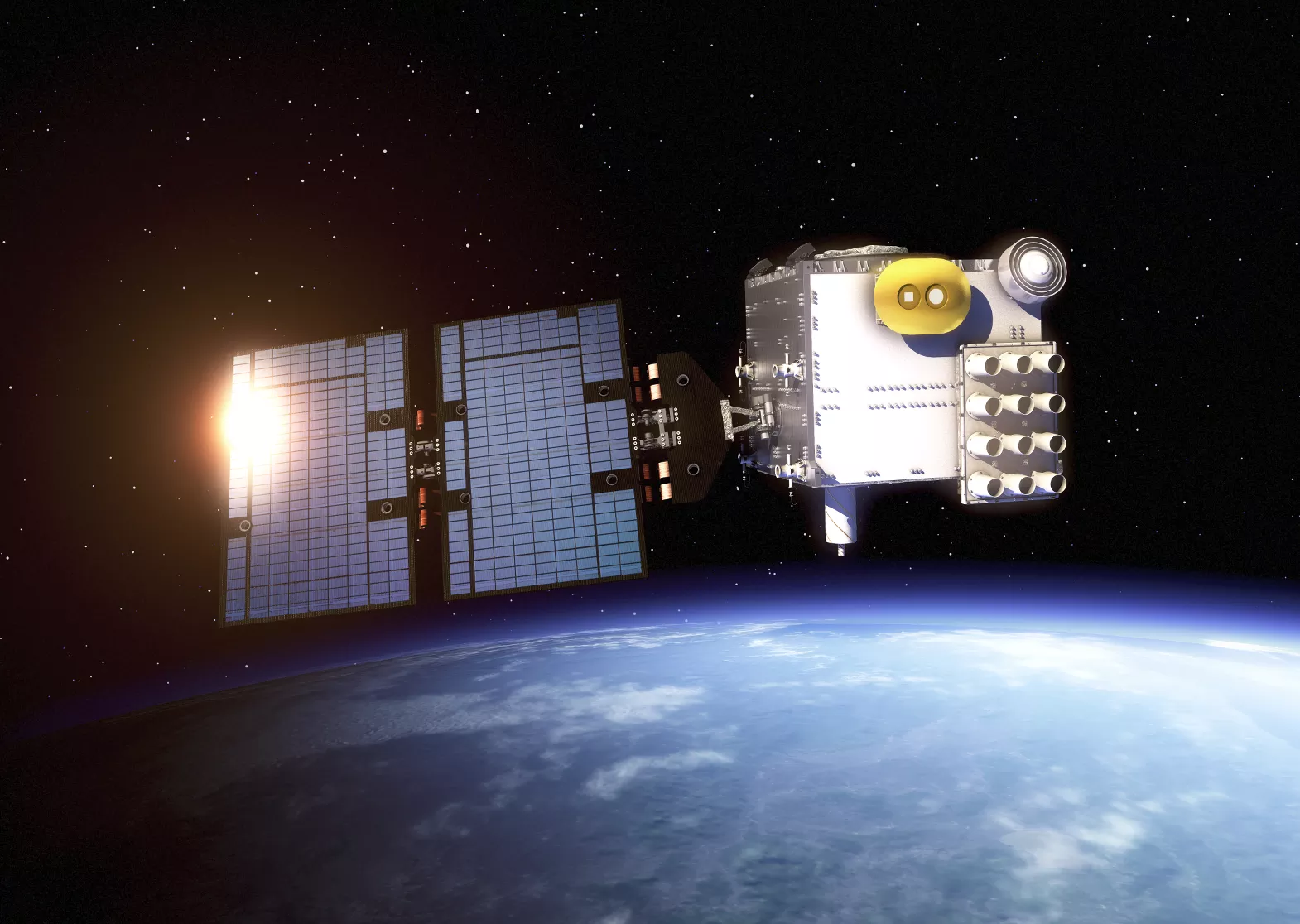
An artist's rendering of one of the COSMIC-2 satellites in space. Credit: SSTL
Satellites
Satellites orbit in space beyond the Earth’s protective atmosphere. There, they are more vulnerable to space weather. As a key element of communications, GPS navigation and weather forecasting, satellite damage can have far-reaching impacts.
Solar radiation can damage satellite parts and electronics, leading to system errors or phantom commands. While generally minor, phantom commands could affect a thruster, causing the satellite to point away from Earth. Over time, radiation can degrade solar arrays and damage instruments almost to the point of complete failure.
Space weather can also affect a satellite’s orbit. Strong solar storms can heat Earth’s upper atmosphere, expanding it slightly and altering its density. This small change can increase atmospheric drag on low-Earth orbiting (LEO) satellites. Extra drag can slow satellites in their orbit, or even cause them to lose altitude. NOAA’s most recent satellite series have thrusters to keep them on track. Satellites that drift out of their orbits risk hitting other satellites or space debris.
Power Grids
Geomagnetic storms can cause large currents in the Earth's surface called geomagnetically induced currents (GICs). GICs can flow into conductors such as power lines and damage high-voltage transformers. In the past, they have led to widespread power outages.
Pipelines
Ground currents from geomagnetic storms can also affect oil and gas pipelines, which are made from steel with a special coating that helps resist corrosion. However, ground currents may speed up corrosion, causing damage and shortening the pipeline’s service life.
Communication and Navigation Systems

The representation of Earth’s magnetic field, called the World Magnetic Model, is the standard model for navigation, altitude, and heading referencing systems that use the geomagnetic field. Credit: NOAA
Our world moves fast because we can rely on technology to keep us going. Devices link us to the rest of the world, and GPS guides us to our destinations. It’s a part of our daily lives, but what happens when things go wrong?
Radio Blackouts
Energy from solar flares can change the composition of Earth’s upper atmosphere by stripping molecules (e.g. N2 , O2 , O) of their electrons. This increase of free electrons can disrupt high-frequency (HF) radio signals to the point of a radio blackout on the sunlit side of the Earth. A blackout would affect air traffic control, the military, and amateur radio, all of which use HF radio signals. A loss of HF radio can pose a risk to national security. It can also affect planes flying near the poles, where the impact is greatest.
GPS Navigation
Strong solar flares can also affect GPS. GPS radio signals have to travel from the satellite through the ionosphere to a receiver on the ground. The effects of solar flare disruptions can range from errors of a few meters to the complete loss of GPS signal. Even small errors can affect navigation used in industries such as shipping, aviation and farming.
Transportation and Human Health

Alaska’s high latitude increases exposure to space weather, which can disrupt communications and navigation systems. Credit: Steve Betts, Flickr (CC).
There are more than 100,000 flights zipping around our globe every day. Before each flight, safety checks are performed to ensure smooth travel. One of the safety factors considered every day is space weather, and for good reason. Space weather can affect the aircraft and the health of those on board.
Aviation
At the North and South Poles, openings in Earth’s magnetic field funnel charged particles downward, allowing them to collide with Earth’s atmospheric gases. Severe space weather can affect GPS and radio communications in these areas. Planes flying on high-altitude transpolar routes must be aware of the space weather forecast before taking flight, as a loss of radio signal can prevent pilots from speaking with ground control. While planes have backup systems to use during solar events, there are still times when they must reroute. In extreme cases, flights must reroute for the health of those on board, as they may be exposed to a higher dose of radiation.
Astronauts
For astronauts outside Earth's atmosphere and magnetic field, space weather events pose a substantial health risk. Exposure can lead to acute radiation sickness and other long-term health effects.
The Bright Side of Space Weather

A view of the aurora borealis taken from the International Space Station over the southern Indian Ocean. Credit: NASA
The same solar storms that disrupt radio and GPS also create a harmless effect called the aurora borealis (northern lights) and aurora australis (southern lights). Charged solar particles interact with gases in the Earth's upper atmosphere, causing them to emit lights that dance across the sky. While they are often seen only near the poles, a strong solar storm can cause the northern lights to appear as far south as Florida.


