



NOAA's SOLAR-1 Detects Space Weather
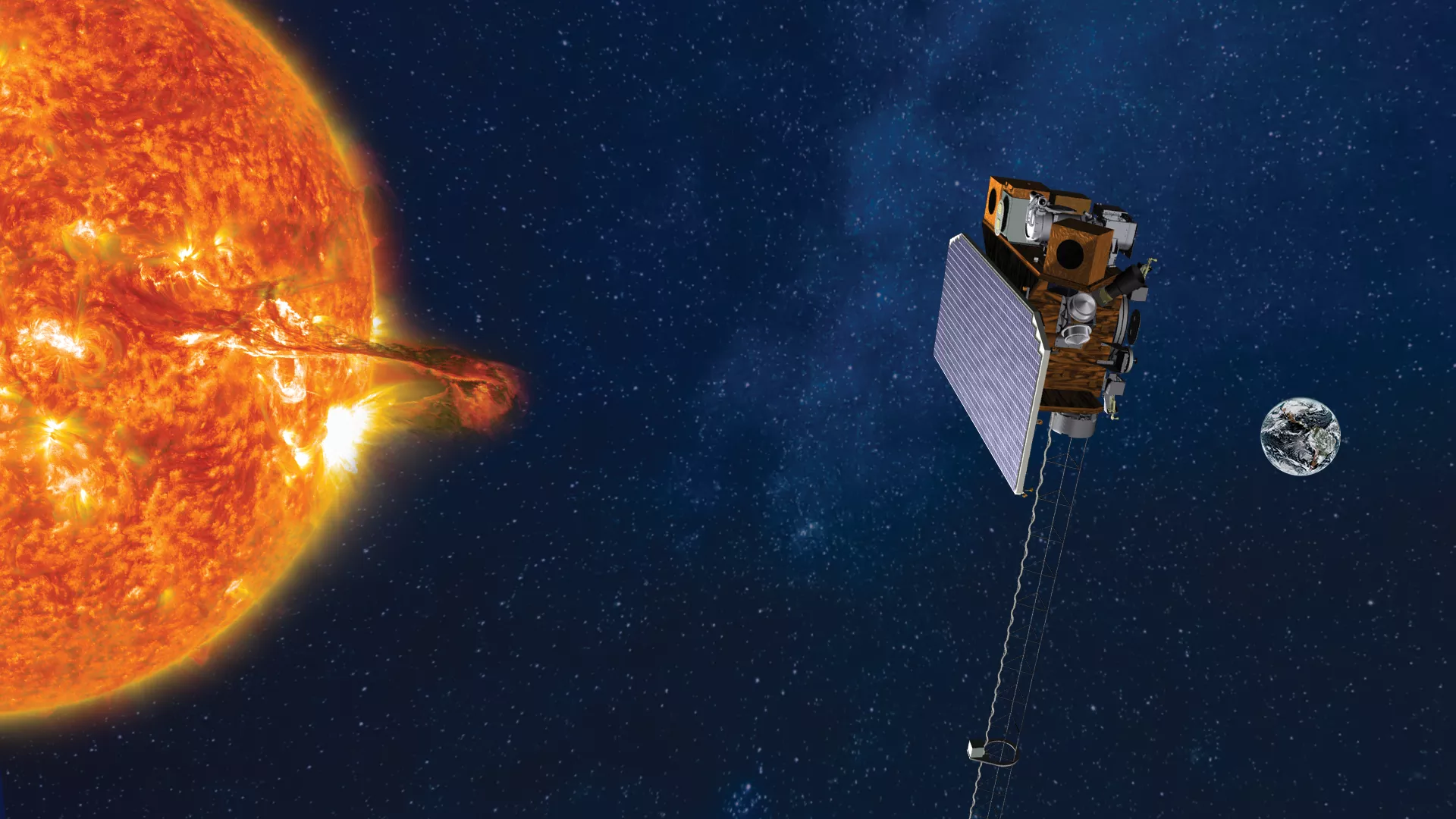
Space Weather Observations at L1 to Advance Readiness – 1 (SOLAR-1), formerly known as Space Weather Follow On – Lagrange 1 (SWFO-L1), keeps a watchful eye on the sun and near-Earth environment for space weather activity, using a special solar telescope to monitor the sun's activity in addition to a suite of instruments to make real-time measurements of the solar wind.
The 24/7 data from SOLAR-1 is transmitted to Earth in real time to give operators critical lead time to take precautionary actions that protect vital infrastructure, economic interests and national security both on Earth and in space.
The SOLAR-1 observatory serves as an early warning beacon for disruptive space weather events that could impact daily technologies, such as GPS, power grids, and radio transmission. By constantly streaming data to Earth, it offers improved performance and faster delivery to NOAA’s SWPC. For example, imagery from SOLAR-1’s coronagraph is in the hands of forecasters within 30 minutes, compared to other data sources that can take up to 8 hours. Data from other instruments onboard are available within 5 minutes. These data are critical to the accuracy of the space weather warnings from NOAA’s SWPC.

Road to Launch and Journey to L1
Timeline
- January 2025: Completed end-to-end testing
- February 2025: Began storage period
- March - September 2025: Mission rehearsals conducted
- July 20, 2025: The observatory arrived at NASA’s Kennedy Space Center
- September 17, 2025:
- Encapsulated in the rocket fairing
- September 21, 2025:
- Rolled out to the launch pad
- September 24, 2025:
- Launched from NASA’s Kennedy Space Center
- Separated from Space X Falcon 9
- Acquired first signal
- Early January 2026: Arrival at Lagrange Point 1, nearly 1 million miles from Earth
- January 23 2026: Executed its final engine burn, successfully entering its final orbital position and renamed from SWFO-L1 to SOLAR-1
- Mid-year 2026: Commissioning complete, transitioning from development and launch to observatory's operational phase

Road to Launch and Journey to L1
Timeline
- January 2025: Completed end-to-end testing
- February 2025: Began storage period
- March - September 2025: Mission rehearsals conducted
- July 20, 2025: The observatory arrived at NASA’s Kennedy Space Center
- September 17, 2025:
- Encapsulated in the rocket fairing
- September 21, 2025:
- Rolled out to the launch pad
- September 24, 2025:
- Launched from NASA’s Kennedy Space Center
- Separated from Space X Falcon 9
- Acquired first signal
- Early January 2026: Arrival at Lagrange Point 1, nearly 1 million miles from Earth
- January 23 2026: Executed its final engine burn, successfully entering its final orbital position and renamed from SWFO-L1 to SOLAR-1
- Mid-year 2026: Commissioning complete, transitioning from development and launch to observatory's operational phase
An Early Warning Beacon
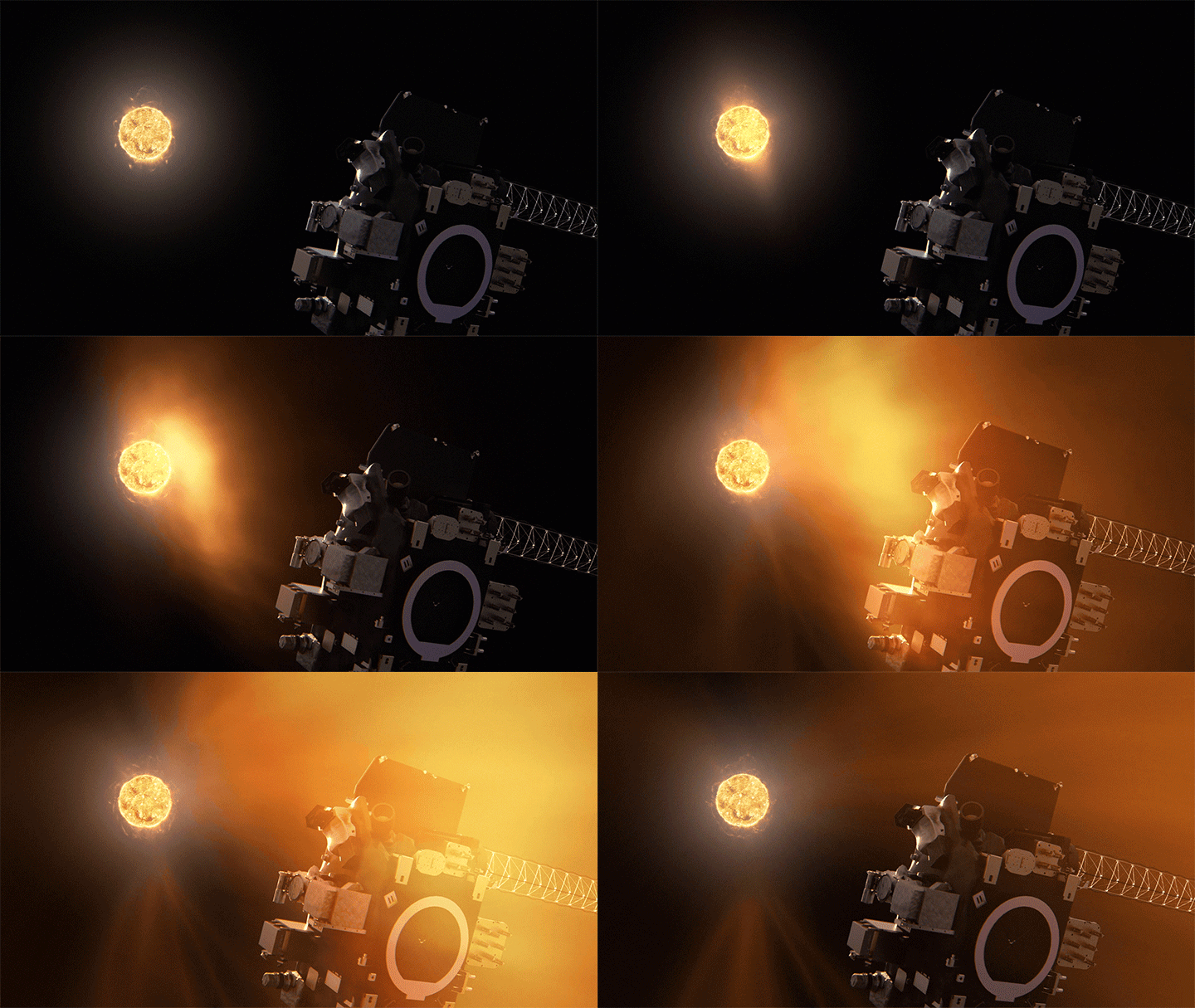
Located at Lagrange point 1, about a million miles from Earth, SOLAR-1 continuously monitors solar wind disturbances and track Coronal Mass Ejections (CMEs) before they reach Earth.
By detecting solar storms in advance, the observatory will serve as an early warning beacon for potentially disruptive space weather events.
An Early Warning Beacon
Located at Lagrange point 1, about a million miles from Earth, SOLAR-1 continuously monitors solar wind disturbances and track Coronal Mass Ejections (CMEs) before they reach Earth.
By detecting solar storms in advance, the observatory will serve as an early warning beacon for potentially disruptive space weather events.

Benefits
As an operational observatory, SOLAR-1 delivers real-time data to NOAA’s Space Weather Prediction Center (SWPC), enabling faster and more accurate forecasts, watches, and warnings. This critical information helps protect the nation's power grid, communication and navigation systems, and supports the safety of astronauts and space-based infrastructure. Key industries and assets vulnerable to space weather are listed in the graphic.

Benefits
As an operational observatory, SOLAR-1 delivers real-time data to NOAA’s Space Weather Prediction Center (SWPC), enabling faster and more accurate forecasts, watches, and warnings. This critical information helps protect the nation's power grid, communication and navigation systems, and supports the safety of astronauts and space-based infrastructure. Key industries and assets vulnerable to space weather are listed in the graphic.
SOLAR-1 is American Made
The spacecraft and instruments were built in collaboration with public and private sector entities to meet the needs of the mission.
- Observatory assembled and spacecraft built by BAE Systems in Boulder, CO
- Compact Coronagraph (CCOR-2) by U.S. Naval Research Laboratory in Washington, DC
- Solar Wind Plasma Sensor (SWiPS) by Southwest Research Institute (SwRI) in San Antonio, TX
- SupraThermal Ion Sensor (STIS) by University of California in Berkeley, CA
- Magnetometer (MAG) by University of New Hampshire in Durham, NH and SwRI in San Antonio, TX
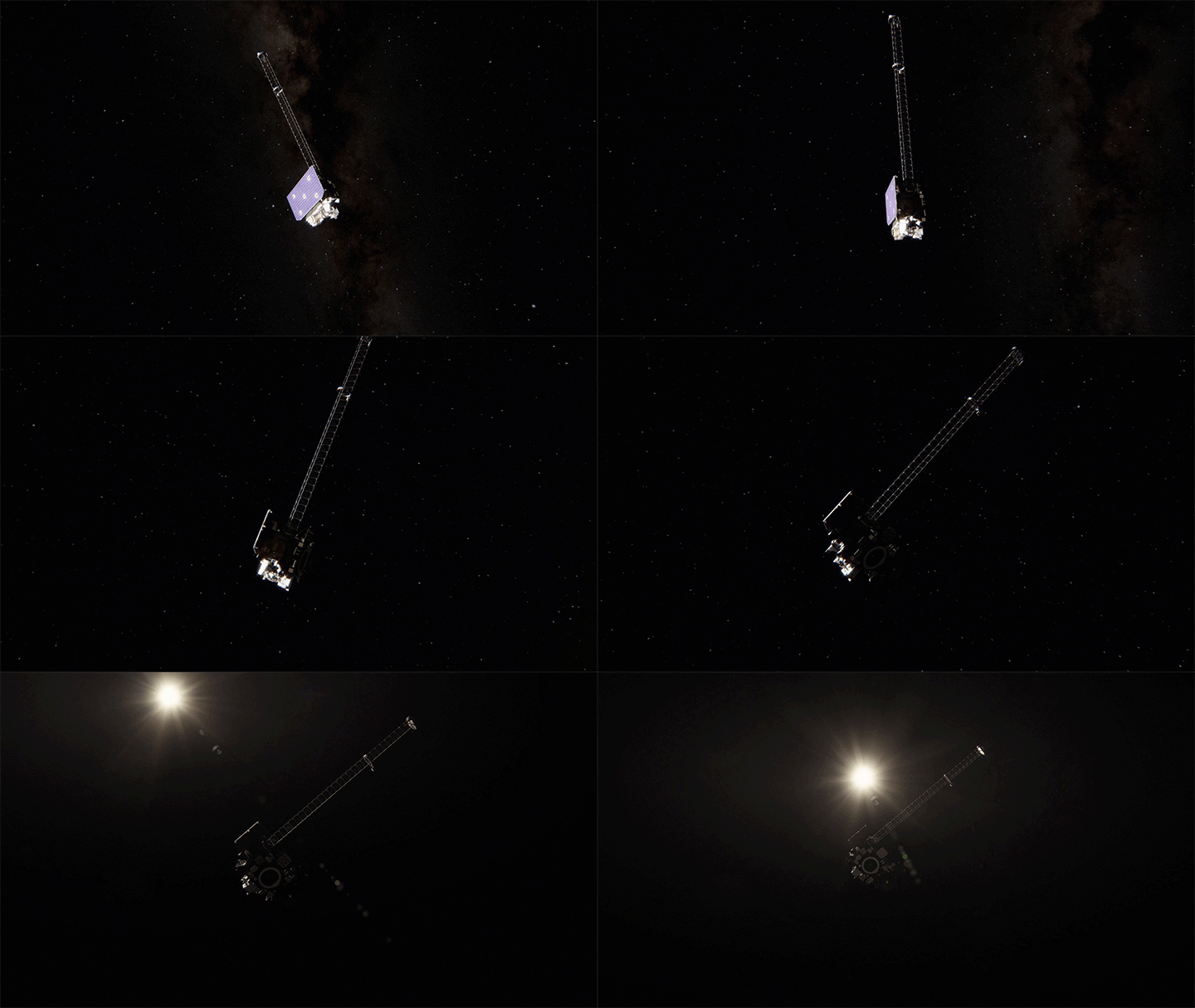
Image Credit: BAE Systems
SOLAR-1 is American Made
The spacecraft and instruments were built in collaboration with public and private sector entities to meet the needs of the mission.
- Observatory assembled and spacecraft built by BAE Systems in Boulder, CO
- Compact Coronagraph (CCOR-2) by U.S. Naval Research Laboratory in Washington, DC
- Solar Wind Plasma Sensor (SWiPS) by Southwest Research Institute (SwRI) in San Antonio, TX
- SupraThermal Ion Sensor (STIS) by University of California in Berkeley, CA
- Magnetometer (MAG) by University of New Hampshire in Durham, NH and SwRI in San Antonio, TX
Image Credit: BAE Systems

